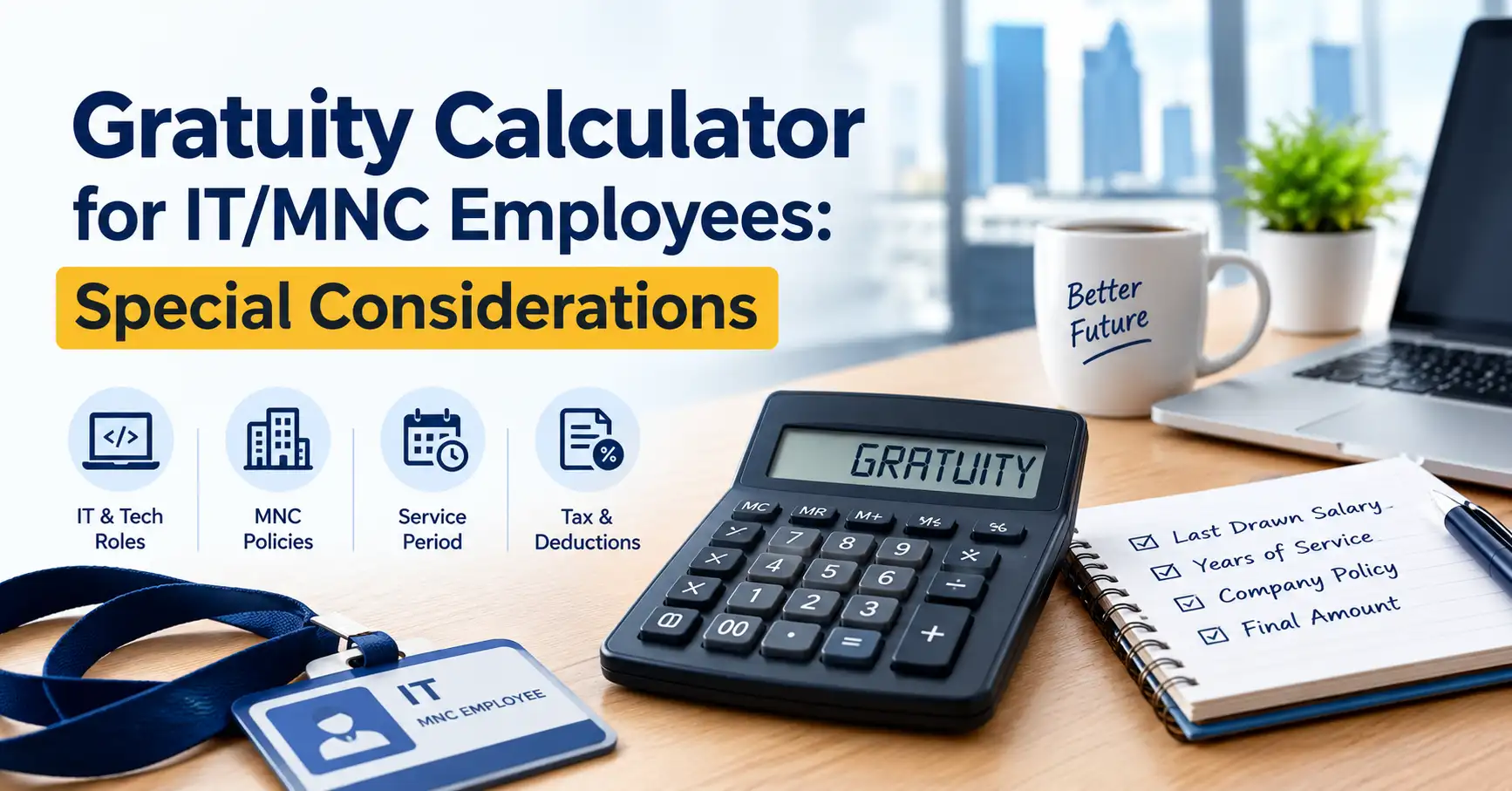
Gratuity Calculator for IT/MNC Employees: Special Considerations
IT professionals and employees at multinational companies in India often assume gratuity works the same way for everyone. In principle, it does. The same Payment of Gratuity Act, 1972, now folded into the Code on Social Security, 2020, governs every eligible employer. In practice, though, the way IT and MNC salaries are structured, the pace at which people change jobs in this sector, and the specific HR policies large corporations follow all create a few wrinkles that are worth understanding before you rely on a rough estimate.
If you work in tech, product, consulting, or at a large multinational, this guide walks through the details that matter specifically to you, from how your CTC structure affects your gratuity calculation, to what happens during layoffs, resignations, and international transfers.
Why IT and MNC Employees Need to Look Closer
Three things make gratuity a slightly different conversation for this group of employees compared to, say, someone working in a traditional manufacturing unit or public sector role.
First, CTC structuring in IT and MNC companies tends to be more complex, often including variable pay, performance bonuses, stock options, and multiple allowances layered on top of a comparatively modest basic salary. Since gratuity is calculated only on basic pay plus dearness allowance, this structuring directly affects your final payout.
Second, attrition and job switching are far more common in this sector than in many others. Many IT professionals move employers every two to four years, which means the five-year eligibility threshold is something people bump up against constantly, unlike sectors where long tenures with a single employer are more typical.
Third, MNCs frequently have their own internal HR policies layered on top of statutory requirements, sometimes offering gratuity-like benefits earlier than the legal minimum, or structuring exits, especially during layoffs, in ways that affect how and when gratuity is paid out.
How Salary Structuring Affects Your Gratuity
Gratuity uses only your last drawn basic salary plus dearness allowance in its formula. This is a key detail for IT and MNC employees, since a large share of total compensation in this sector often comes from components that are excluded from the calculation, such as special allowances, performance bonuses, joining bonuses, and the value of vested stock options.
The standard formula remains:
Gratuity = (Last Drawn Salary x 15 x Number of Years of Service) / 26
Here, Last Drawn Salary means basic pay plus DA only. If your basic salary is a relatively small slice of your total CTC, which is common in many tech companies, your gratuity payout will reflect that smaller base rather than your full package.
Example: Suppose your total CTC is 18 lakh per year, but your basic salary plus DA works out to only 6 lakh annually, or 50,000 a month. After 6 years of service: Gratuity = (50,000 x 15 x 6) / 26 = approximately 1,73,077. Notice how this figure is tied closely to the basic pay component, not your headline CTC figure.
The New Wage Definition Could Change This
Under India’s new labour codes, the definition of wages has been revised specifically to address this kind of structuring. Basic pay plus dearness allowance plus retaining allowance must now make up at least 50 percent of an employee’s total CTC. If allowances and other components push this ratio above 50 percent, the excess is treated as wages for the purpose of calculating gratuity and other statutory dues.
This is particularly relevant for IT and MNC employees, since many companies in this sector have historically kept basic pay low relative to total compensation, precisely the kind of structuring this rule targets. As companies restructure salary breakups to comply, many IT employees could see a meaningfully higher gratuity calculation base going forward, even without any change in their total CTC.
Notice Period Buyouts and Your Last Drawn Salary
Notice period handling is another area where IT and MNC practices can affect gratuity in subtle ways. If you resign and your employer allows a notice period buyout, where you pay to leave early or the company waives part of the notice, your last working day and your last drawn salary figure should still be based on your actual employment terms at exit, not an adjusted figure.
It is worth confirming with your HR team exactly which month’s basic salary and DA will be used for your gratuity calculation, particularly if your exit involves a buyout, garden leave, or a transition period, since disputes over the exact last drawn salary figure are not uncommon in fast-moving tech exits.
Layoffs and Gratuity: What IT Employees Should Know
Mass layoffs have become more visible in the tech sector over the past few years, and gratuity eligibility during a layoff works the same way as any other form of exit under the Act. If you have completed five years of continuous service, or one year if you are on a fixed-term contract under the new labour code provisions, you remain entitled to gratuity regardless of whether you resigned or were let go as part of a restructuring.
Employers are required to pay gratuity within 30 days of it becoming due, and this obligation does not change simply because the exit was involuntary. If your gratuity is delayed following a layoff, you are entitled to interest on the outstanding amount, and it is worth raising this directly with HR or, if needed, escalating to the appropriate labour authority.
International Transfers and Overseas Postings
A question specific to MNC employees is what happens to gratuity eligibility if you are transferred to an overseas office of the same company, or seconded to a group entity abroad for part of your tenure. This is a nuanced area, and the answer often depends on how your employment contract is structured, specifically whether your service is considered continuous with the Indian entity throughout the overseas assignment, or whether it is treated as a break in service with the domestic company.
If you have had, or expect to have, an international posting during your tenure, it is worth getting written clarification from HR on how this period will be treated for gratuity purposes, rather than assuming continuity by default.
Stock Options, Bonuses, and What Gets Excluded
It is worth repeating clearly, since this trips up many IT and MNC employees: Employee Stock Ownership Plans, joining bonuses, performance bonuses, and most special allowances are excluded from the gratuity calculation entirely. Only basic salary and dearness allowance count. If a large part of your compensation growth over the years has come through bonuses and stock grants rather than basic salary increments, your gratuity may be smaller relative to your total earnings than you might expect, which is worth factoring into your broader financial planning.
Tax Treatment Remains the Same
For private sector IT and MNC employees, the tax exemption on gratuity follows the standard rule. The exemption is the lowest of the actual gratuity received, the statutory cap of 20 lakh, or the amount calculated using the standard formula. Anything received above this exempt limit is added to your taxable income under the head Income from Salary and taxed at your applicable slab rate.
Getting an Accurate Estimate
Because CTC structures in IT and MNC roles can be complex, relying on a rough mental calculation or comparing notes with a colleague at a different company is rarely accurate. The safest approach is to check your latest payslip for the exact basic salary plus DA figure, confirm your total years of continuous service, and run the numbers properly.
Our Gratuity Calculator lets you plug in your actual basic salary plus DA and years of service to get an instant, accurate estimate, along with a breakdown of the tax-free and taxable portions. If you are also weighing what to do with your gratuity once it arrives, whether that is parking it safely in a Fixed Deposit Calculator or growing it over the long term through a SIP Calculator, it helps to plan both sides of the equation together.
Conclusion
Gratuity rules do not change for IT and MNC employees, but the way compensation is structured in this sector means the practical outcome often looks different from what a simple CTC-based guess would suggest. Understanding what counts as your last drawn salary, how the new wage definition might raise your calculation base, and how layoffs, notice periods, and international transfers are treated can help you walk into any exit conversation with realistic expectations rather than surprises.