How to Invest Your Gratuity Amount Wisely: FD, PPF, SIP Comparison
After years of loyal service, gratuity finally lands in your bank account as a single, sizable lump sum. For many employees in India, it is one of the largest one-time payments they will ever receive from an employer. And yet, a surprising number of people let this money sit idle in a savings account, earning next to nothing, simply because they never planned what to do with it.
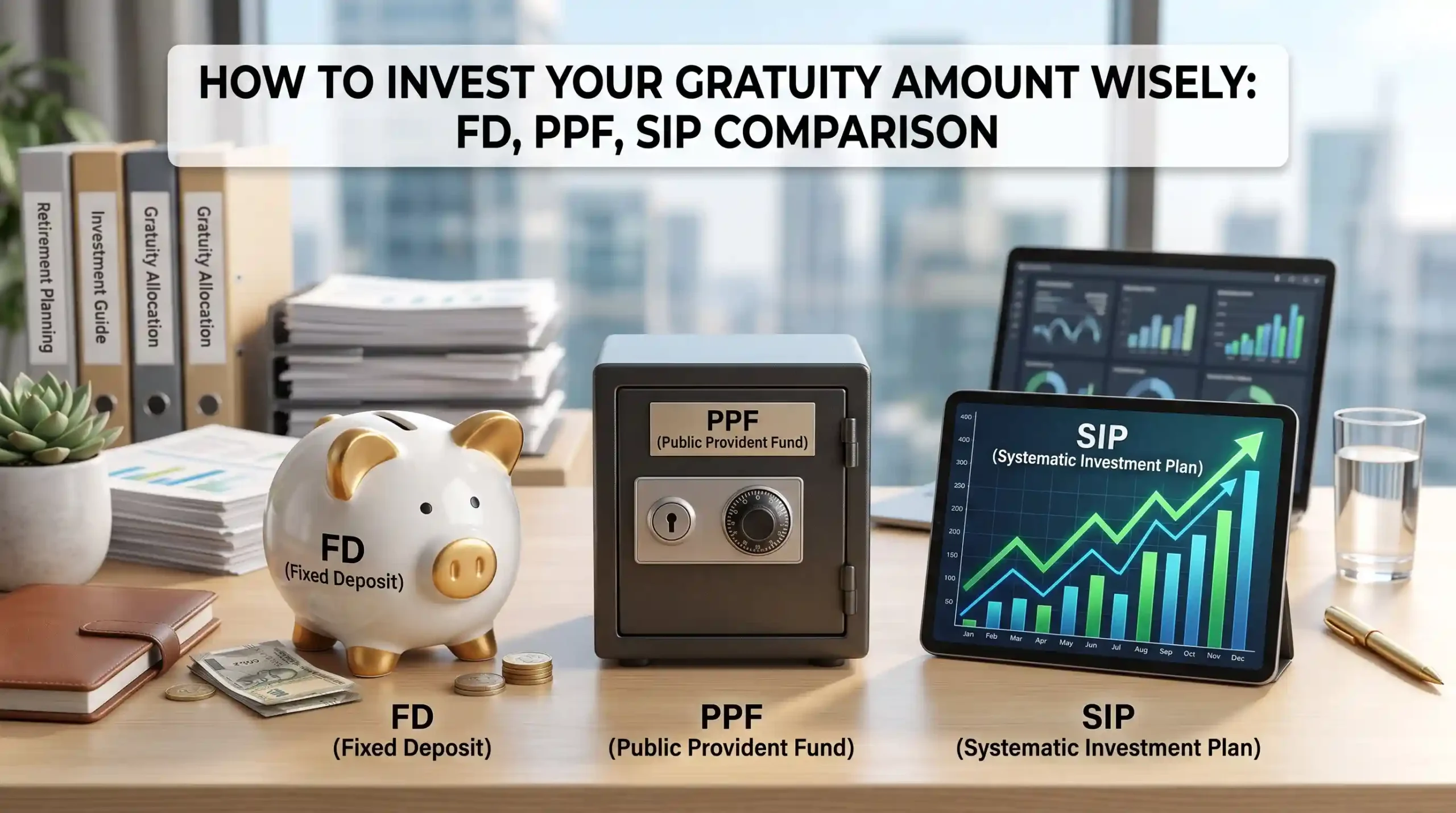
If you have recently used a gratuity calculator to estimate your payout, or you already know the exact figure your employer owes you, the next question is far more important than the calculation itself: where should this money go? This guide breaks down three of the most popular and reliable investment routes for gratuity funds in India, Fixed Deposits, the Public Provident Fund, and Systematic Investment Plans, so you can decide what fits your goals, your risk appetite, and your timeline.
Why It Matters How You Invest Your Gratuity
Gratuity is not just another bonus. It is often meant to serve as a financial cushion for retirement, a bridge income while you look for the next opportunity, or a way to fund a major life goal like your child’s education or your own medical security in later years. Because it usually arrives at a significant life stage, whether that is retirement, resignation, or a career change, how you deploy this money can shape your financial stability for years.
Three mistakes are common with gratuity payouts. People leave it in a low-interest savings account, they spend it on non-essential purchases without a plan, or they invest the entire amount in one instrument without considering diversification. A smarter approach is to split the amount across instruments based on when you will need it and how much risk you can comfortably take.
Fixed Deposits: Safety and Predictability
A Fixed Deposit, or FD, remains the most familiar investment option for Indian households, and for good reason. It offers a fixed rate of return over a chosen tenure, ranging from a few months to several years, and your principal is protected regardless of market movements.
Why FDs work well for gratuity money:
- Your capital is not exposed to market volatility, which matters if you are retired or nearing retirement and cannot afford to lose principal.
- Interest rates are known upfront, so you can plan your cash flow with certainty.
- Senior citizens usually get a higher interest rate than the standard rate offered to other depositors.
- Liquidity is reasonable, since most banks allow premature withdrawal, though usually with a small penalty.
The trade-off: FD returns are fully taxable as per your income tax slab, and once inflation is accounted for, the real return can be modest. FDs work best as the “safety bucket” of your gratuity, the portion you may need within the next one to three years, rather than your primary long-term wealth builder.
If you want to see exactly how much your gratuity amount could grow over a chosen tenure, our Fixed Deposit Calculator lets you compare different interest rates and durations before you commit.
Public Provident Fund: Long-Term, Tax-Free Growth
The Public Provident Fund, or PPF, is a government-backed savings scheme designed specifically for long-term wealth creation, with a lock-in period of 15 years. It is one of the few investment instruments in India that enjoys triple tax benefit status, meaning the amount invested, the interest earned, and the maturity amount are all exempt from tax.
Why PPF suits a portion of your gratuity:
- The interest rate, though revised quarterly by the government, has historically been higher than most FD rates.
- Because it is backed by the Government of India, capital safety is essentially guaranteed.
- The long lock-in period discourages impulsive withdrawal, which can be an advantage if you are trying to preserve a retirement corpus rather than spend it early.
- Partial withdrawals are allowed after the sixth year, offering some flexibility if genuinely needed.
The trade-off: The annual contribution limit is capped, and your money is locked away for a long period, so PPF is not suitable if you expect to need the funds within the next few years. It works best for the portion of your gratuity earmarked for a distant goal, such as your own retirement corpus fifteen or twenty years down the line, or a child’s future education.
You can check how a lump sum from your gratuity, combined with the annual PPF contribution limit, might grow over the full tenure using our PPF Calculator.
Systematic Investment Plans: Growth Potential Through Mutual Funds
A Systematic Investment Plan, or SIP, is a method of investing a fixed amount regularly into mutual funds, rather than putting in a lump sum all at once. While gratuity itself arrives as a lump sum, many financial planners suggest parking part of it in a liquid fund first, then transferring it gradually into equity mutual funds through a SIP, a strategy sometimes called a Systematic Transfer Plan.
Why SIPs deserve a place in your gratuity plan:
- Historically, equity mutual funds have offered higher long-term returns compared to fixed-income instruments like FDs and PPF, though this comes with market-linked risk.
- Rupee cost averaging, buying more units when prices are low and fewer when prices are high, helps smooth out market volatility over time.
- SIPs offer flexibility. You can increase, decrease, pause, or stop contributions based on your changing needs.
- Over a long horizon of ten years or more, SIPs are well suited to beating inflation, something pure fixed-income instruments often struggle with.
The trade-off: Returns are not guaranteed and depend on market performance, so this route is better suited to the portion of your gratuity you can afford to leave invested for the medium to long term, rather than money you might need urgently.
If you already have some gratuity funds you would like to invest steadily into equity or hybrid mutual funds, our SIP Calculator can help you project how a monthly contribution, growing at an assumed rate of return, might look after five, ten, or twenty years.
FD vs PPF vs SIP: A Quick Comparison
| Factor | Fixed Deposit | PPF | SIP (Mutual Funds) |
| Risk level | Very low | Very low | Moderate to high, market linked |
| Typical horizon | Short to medium term | Long term (15 year lock-in) | Medium to long term |
| Tax treatment | Interest is taxable | Fully tax-free | Gains taxed as per holding period and fund type |
| Liquidity | Moderate, with penalty on early exit | Low, limited withdrawal before year 6 | High, though best avoided in the short term |
| Best suited for | Emergency reserve, near-term goals | Retirement corpus, tax-free long-term saving | Wealth creation over a long horizon |
How to Split Your Gratuity Amount
There is no single formula that fits everyone, since your age, dependents, existing savings, and risk comfort all play a role. That said, a commonly used approach is to think in three buckets:
- Short-term safety bucket (needed within 1 to 3 years): Keep this in an FD or a liquid fund so it stays accessible and protected.
- Long-term, guaranteed bucket (needed after 10 to 15 years): Route this into PPF for its safety and tax-free compounding.
- Growth bucket (needed after 5 years or more, and you can tolerate some ups and downs): Consider SIPs in mutual funds for the potential to outpace inflation.
If your gratuity payout is affected by salary restructuring under the new labour codes, it is also worth revisiting your Cost to Company breakup and comparing your gratuity liability against how you have structured other savings. Our Compound Interest Calculator can be a useful companion tool when comparing how different instruments compound over the same time horizon.
Conclusion
Your gratuity is a reward for years of dedicated service, and how you invest it deserves the same thought you would give to any major financial decision. Rather than choosing a single instrument, consider spreading your gratuity across Fixed Deposits for safety, PPF for tax-free long-term growth, and SIPs for wealth creation potential, based on when you will actually need each portion of the money. Before you decide, it also helps to know exactly what you are working with. Use our Gratuity Calculator to get an accurate estimate of your payout, then plan your investment strategy around that number rather than a rough guess.